S4/E2 Moving right along

I was intent on getting E1 in during 2024, which is to say 50 years since I composed my earliest circulating work. Inasmuch as I was up to op. 84, though, before finally releasing it, it was assigned the misleading opus number 85! Back in 1975 I began work on what would be my op. 1, and now, 50 years removed from then, I’m about to plunge into those waters.

But two observations before I do; one looks back to text from 2024 I already used in E1, and the other expands on even earlier texts I plan to paste into E3. (Rather than revise what was in one, and will be in the other, I choose to reflect on the topics in greater depth here.) First, let me discuss the stamping I call for in op. 85. Back in my 20s, I tried playing the soprano, alto and tenor parts whilst stamping and had no trouble coordinating the two activities. But I am an organist, and thus used to independent rhythmic activity in my feet. Moreover, I have never owned a bass, but years later, when just holding one, I found it unwieldy indeed! This alone calls the whole concept of asking wind players to stamp as they played into question. And the idea of asking transverse players, with their delicate embouchure, to do so has now come to seem preposterous. My smarmy comment about the struggling flute players at the premiere embarrasses me now, when I am more inclined to say, “Bless them for trying”! At all events, I have now appended the following performance note to all op. 85 scores:

Performance note
Stop-time rags such as this are of course part of the piano rag tradition. The stamps appearing in all parts are optional (for the group or an individual player), and might be fun to try in rehearsal or informal performance. But to avoid any issues with regard to embouchure in formal settings, I recommend either ignoring the markings, or bringing in a separate percussionist (who could play any unpitched instrument).

◊◊◊◊◊◊◊◊◊◊◊◊◊◊◊◊◊

Now I am in the odd position of commenting on text which I wrote before (1996 program notes), but have not yet incorporated into this blog. (It will figure in E3, below. And in case that is not already clear, “below” for me represents text I have yet to write. Some of you approach the texts latest to earliest, others vice versa, which makes the matter relative!) It again involves belying a superficial comment. The middle numbers (of four) in op. 1 are joined at the hip and cannot be performed separately. I attributed this blandly to the “simple coincidence” that each begins with the same two notes. (Spelled as D-D# in the first number; D-Eb in the other.) But the dovetail only works because the two notes occur respectively right before the next barline, making the transitional iteration an utter surprise when it suddenly lands us in an “unrelated” key! What is more, the tactus remains the same between numbers, such that the two notes are identical in both pitch and tempo. I also noticed later that the two numbers are identical in structure. In their shared binary (AABB) form, each A is twice the length of the corresponding B. The rustic Ländler (op. 1, no. 2) moves from loud to soft; the dreamy Lullaby (op. 1, no. 3) continues the diminuendo, from soft to softest. I promise to address the bookending numbers that remain in E3, but for now you can listen to the concatenated middle pair I discussed here first.

“Lack of early training,” I write, or “juvenilia”? Perhaps, but in op. 1 I was clearly making up for lost time!
S4/E1 Earliest circulating composition

I’ve embarked on writing an essay I’m calling Retrospective on a Composer’s Career. I wanted to mark my 50th anniversary as a composer, which until recently I thought would be falling next year. But in the kind of wrinkle that characterizes my life generally, the timetable has moved itself up! I will be adapting the essay for use here, where I can organically interpolate musical examples or the occasional graphic with the least fuss. So, here goes.

◊◊◊◊◊◊◊◊◊◊◊◊◊◊◊◊◊

April 2024

This comprehensive survey actually started life with the August 2020 entry that has now been pushed below, where I was naturally expecting to begin things with my opus 1 Divertimento. This incorporates music I worked on between 1975 and 1977. But in my archives lay the hoary manuscript of a rag I had written for recorder quartet toward the end of 1974. When I reviewed it, later that year 2020, I determined that it was worthy of release if I could just touch it up a bit! Having done so, I gave the reupholstered rag my next available opus number (85), and also arranged it for flute quartet. (The analogies are strong between the two ensembles. They both have the family’s main instrument, viz., alto recorder and the standard flute, in second position, with the highest member an octave higher, and two more members extending the group’s composite range that much more below.)

I mention below that this sexagenarian (and now septuagenarian) retrospective will largely expound upon the program notes I already have for each composition. Here are the ones I finally wrote for the rag I so long suppressed.

◊◊◊◊◊◊◊◊◊◊◊◊◊◊◊◊◊

100% Rag for SATB recorders, op. 85

My development as a composer was slow, and followed a late start owing to lack of early training. It is thus that a piece like this from my college days counts as so much juvenilia. In December of 1975, I began sketching the earliest music from my op. 1 orchestral set, ultimately to be its finale. The present work had directly preceded it, the previous year. Thematic material from that time has meanwhile been available for tapping into later works, including one motive in a work as recent as my op. 70 cantata. But this rag was of such coherent structure (however unorthodox) that it resisted any disassembly. A few days ago, that is to say, more than 45 years since it was first written, I realized that I could release the work after a bit of polishing, which I have now done. But despite the new opus number, I emphasize that 100% Rag is 99.99% a product of 1974!

The title was more than a pun on the term used by stationers for certain high-end papers with maximal cotton fiber content. It was a protest of authenticity against some who averred that the first theme (after the four-bar intro) begins with a long upbeat rather than bona fide syncopation, while the leisurely final theme has but one syncopated measure before the rag unexpectedly concludes back in stop-time mode. Let me refer them now to the final strain of Joplin’s Chrysanthemum, which is completely unsyncopated, or to the second strain of my favorite rag of all, the master’s Wall Street Rag, which uses syncopation only just before its final cadence. Although rags conventionally have but one tempo marking stipulated at the outset, no-one ever plays them that way. I went formally with two contrasting tempi, slow for the intro and first strain, fast for the second strain. The first strain comes back again in accordance with tradition, but then its intro is presented in a fast variant to usher in a “stop-time” section. Players (or a newly employed percussionist) are free to stamp the main beat. But when the final strain slows down it is in precisely the tempo of the rag’s slower opening. (A nicety I just became aware of all these decades later!) A final cadence in stop time rounds off the work, restoring as I said the (literally) foot-tapping syncopation, whose prevalence proves the piece, for all its irregularities, to be indeed 100% rag.

I dedicate the work now to the instrumental polymath Peter Lim, cherishing the idea of inscribing 100% Rag to someone the same age that I was when I first sketched it. (He could, it goes without saying, take any of the parts in a proverbial Augenblick!)

Victor Frost
9 X 20
Baltimore

◊◊◊◊◊◊◊◊◊◊◊◊◊◊◊◊◊

I do not yet at this writing have a recording of the recorder version, but here is a scrolling video of the one for flutes. (There also exists a videotaping of the 46-year-delayed premiere, in a stunning Italian palazzo no less. It features, however, a lady distractingly fanning herself in an impressive 5 against the quartet’s 4! Seriously, the group’s flutes sounded gorgeous at this venue, but when it came to the novel foot stamping in the rag’s closing stop-time section, the players were, shall we say, inconsistent.) In the present video, during repeats, I interpolate pics from both the world premiere and the recording session that followed.

100% Rag, version for four flutes

◊◊◊◊◊◊◊◊◊◊◊◊◊◊◊◊◊

August 2020

I feel as though the best way to afford an overview on my life’s output would be to use the individual sets of program notes I already have as a point of departure, … (to be continued)

S3/E9 Facebook Gestalt (once more with feeling)

When writing the opera, I skipped the Prelude (which actually inhered in Jonathan Clift’s libretto) at first, and began my work instead with Act I, Scene 1. (I knew I would be quoting the Prelude in the opera’s finale, and wanted to be closer to that point when composing it.) Otherwise I followed dramatic order. But not so for the engraving process. Sometimes when I finished a scene, I already had ideas for the next one, so any engraving would have to wait. That meant that sharing any of my new music with followers on Facebook (or occasionally elsewhere) had to wait, since there was no time to prepare the materials for promulgation. (I emphasize again that these materials subsisted primarily to promote the opera with company personnel, or as learning aids for singers; sharings I did with the public on Facebook–or here–have, I admit, been shavings off the proverbial table.)

So a lot of interpolation (no, call it what it is: backtracking!) has been necessary in the exposition of this evening-long work I finished over a year ago now. Act I has a Prelude and four scenes, and Act II has four more scenes. By the time composition ended, I had engraved and shared abroad all of that except Act I, Scene 2. As I have mentioned, it is so long that I broke it up into three chunks. The first two of those chunks are the subject of E6 below. So, with just one more section of less than 10 minutes to go to achieve closure (Gestalt), I encountered the roadblock I chronicle in E7. (You can see why I became so frustradedly cross!) In E8 I exultantly report that the roadblock has finally been lifted, and so I can at last finish this guide with the subjoined video link.

Scrolling of this final section out of Act I, Scene 2 begins with the second system (bottom of the first page) of the video. Now then, finally, if you put that together with everything found below here in S3, as the old song says, “it spells M-O-T-H-E-R!”

Act I, Scene 2c

So, I apologize that this path toward completion of my survey has been so very desultory. I write not to call attention to my prowess as a composer, which is minimal, but to shine a light on my teachers and guides on the inner who somehow got this music through my thick skull and into manifestation. It was quite a ride, I’ll tell you!

If you just want to listen, or follow the odd scrolling video, and not revisit the vicissitudes I chronicled along the way, all the links you need can be found within this master link.

Akhtamar complete samples

S3/E8 WordPress comes through!

Update to E7. A techie at WordPress composed special code to fix the problem I mentioned in E7 about the public display of E6 I was upset about. At first I thought that this was a one-off workaround (something I could possibly have come up with myself, if that was all I coveted…), whereas I wanted a permanent solution. In other words, I didn’t want to have to embed this code every time I wanted to link to a Vimeo video. Also, I assumed that if they had a solution that did work universally, they would just make it part of the code for the entire platform, which would mean it would get fixed in my posting automatically, like any bug fix.

There’s some reason that I don’t quite get for why they can’t incorporate my code into the general one, but it’s still true that I personally don’t ever have to deal with this again: my future Vimeo links will all be as correct as S3/E6 (from last November!) is finally.

S3/E7 Sidetracked by WP’s overreach

The way that E6 below looks to you (at least at this date) is alas! different from what I see in this editor. The Vimeo links in E5 (and earlier) were the old-fashioned underlined, blue-highlighted, hyperlink texts of the type you’ve been clicking on for decades now. But when I went to paste in the links from my latest Vimeos into E6, I found that WordPress had instituted a new feature, which involved creating a thumbnail and title out of the Vimeo metadata. Fancy! Except I learned later that huge blocks of wasted space got interpolated in what WordPress calls the “live” version. So on my creator’s screen, everything looked impressively perfect, but to the user it was an unsightly mess.

I have given them the intervening months to get the bugs out of this new bell and whistle, but it hasn’t happened. Here is my workaround. No more Vimeo links, unless this is fixed someday. (I told them that at this point they should just abandon the new feature; clearly it’s not needed: what’s good enough for E5 would have been good enough for E6!) I will create a document with any links, including Vimeos, compile a pdf of same (for universality), upload to Dropbox and link thereto here.

Roundabout? Indeed, but neatness counts! This pdf has the audio and video links for the whole of Akhtamar. Please do sample at your leisure, at least until such time as the work is mounted.

Akhtamar, audio and video links

S3/E6 Facebook Gestalt

In E3 I said that I planned to favor this forum over Facebook moving forward with discussion of my op. 91. Yet, when I finished engraving the first of three sections in the long Act I, Scene 2 (the very last one, as I have said, still in need of engraving), I posted the video I made therefrom with commentary there, but nothing here. And again, when I recently finished engraving the middle section, I posted the video I prepared from it only on Facebook. At some point I realized that I wanted to have the chronicle there be complete. And indeed, once I finish engraving the shortest, final section of this longest of the opera’s scenes, that will be it for the Facebook phase to my ongoing documentation!

Essentially then, my S3 entries up to now have served to smooth the transfer of the intermittent discussion there to here. I will still go about distilling the Facebook verbiage and hyperlinks into an independent WordPress experience. But right now I need to bring the latest materials to the fore.

I have established that scrolling videos were available for every scene but the second of Act I. The latter is so long that I divided its videography into the three study sections alluded to above. My first catch-up, then, is to paste in the Vimeo link to the video for the first section, and to quote my Facebook commentary.

Akhtamar, Act I, Scene 2a

“The opera’s longest scene is set in the marketplace of Ahlat, on Lake Van’s coast.”

And now, my latest finished work, the subsequent, middle section of the same scene. It begins with just the single, upbeat note in the second flute on the far right of the screen.

Akhtamar, Act I, Scene 2b

“In this pivotal section, Avedis and Tamara meet and fall in love.”

S3/E5 An updated old video

My librettist, who goes by the nom de plume Jonathan Clift, does not read music, and was frustrated by the audio samples I had been releasing on Facebook of music from our opera. Quite frankly, he wanted to see his words as he listened to my music! In my vocal works I repeat words less often than most composers. (In one song cycle I don’t do this at all.) I encouraged him to follow his libretto as he listened, where the rhythm of NotePerformer’s sung oohs would help him keep his place (most of the time, at least), but what he really wanted was a scrolling score video. I rolled up my sleeves and figured out just how to go about this, aware that such a resource would be of even greater utility to singers and staff than the audio I had been issuing up to this point.

The first of these to appear was for what was then the latest written music, Act I, Scene 4. I tidied the score up to the point that others besides myself could actually follow it; I would say that the percentage of the total engraving (which I finally finished a few days ago) was about 35. Many people told me they liked being able to see my libretto setting as well as read the stage directions scrolling by in the video. From then on that’s all I did, although the extra time it took to always do that 35% engraving and video prep meant that my Facebook entries became fewer and farther between. And of course, I also had to write the very music that was being so effectively spotlighted!

I just scrolled down to the original Facebook posting and replaced the old video with this brand new one, with its score now fully engraved and with improvements to the NotePerformer audio realization, utilizing a few tricks I have meanwhile tucked under my belt.

https://vimeo.com/852123842

When I was still limiting myself to audio samples, I had tried to make up for the lack of a visual element with what I called timed synopses. “At 02:32, a character slips on a banana peel, which accounts for the slide whistle followed by bump in bass drum in my score.” These had become supererogatory, although I obviously had great fun writing them up! Now on what Vimeo calls Chapters, I highlight instead certain turning points in the narrative, and one simply clicks straight to that moment in the video. It goes without saying, this will prove enormously useful for performers learning the music.

I am working intermittently on the Chapter index for the newly engraved Act I, Scene 4 as we speak. As you can guess, there are analogies between this and the timed synopsis I described above. Essentially I am paring down the latter so as to yield the former! But there are certain nuances in the unincorporated material I would miss if I couldn’t just preserve them here instead. Each synopsis was designed for real-time use during audio playback. I thus felt free to be that much more more elaborate when describing longer musical passages.

Following are two observations from the Act I, Scene 4 synopsis which alas! ended up on the cutting room floor (with respect to the current Chapter index), but which I feel merit our interest nonetheless.

The first refers back to an earlier synopsis found in “Entry VIII.” I used this method to keep track separately of the opera-related postings amid all the usual Facebook cat pictures or whatever. I confess not to know how many, if any, of the medieval musical developments in Europe ever made their way to Armenia, but I found myself invoking a few of them anyway as the music was emerging! “In my notes below for Entry VIII, I spoke of the medievalism of placing our tenor [Avedis] into a texture between clarinet and bassoon. There he had the melody, as the word tenor itself originally indicated. In later developments on the European continent, the melody passed instead up to the top voice or instrument. That happens now here, where Avedis and bassoon have countermelodies to the clarinet’s tune. (Another reason the music actually sounds somewhat medieval is its use of hemiola, wherein six beats, divided as 2×3, get regularly superimposed on 3×2.)” The foregoing relates to the present Chapter 15 on today’s video.

The other, having formed part of what is now Chapter 17 in the new index, involves a borderline-extreme vocal technique which I indulged in for dramatic effect. “Broken octaves are easy to play on certain instruments (like the piano) but are difficult on winds and all but treacherous for the human voice. Still I assign them to the lovers here, to express the overflow of passion that obtains between them.” Well, at least I made the most difficult octave pair optional! But I live in fear of protracted litigation, notwithstanding.

S3/E4 A new video

Today I finished engraving the last scene of my opera’s first act. That leaves just one to do, but it’s the whopping Scene 2 from the same act. It’s 36 minutes long; that is to say, longer than Scenes 3 and 4 combined!

I am doing this close work in terms of both engraving the music and preparing the NotePerformer mock audio for use by those studying the opera for performance. In this day and age I will be eschewing the traditional piano reduction (except possibly in the few scenes that feature chorus) in favor of scrolling score videos. I frankly admit that the ability to also share these resources with family and friends, while heartening, is essentially a by-product of my ongoing promotional activities.

Eventually, everything will be on video in both of two forms. Individual scenes will be of greatest interest to performers and certain opera company personnel. Those have detailed synopses with corresponding timings to help facilitate musical and dramatic preparation. Most of my followers, though, just want to hear the music, see the lyrics as they scroll by, and possibly pause the video to take in the stage directions in the score from time to time. For them there will be three more substantial chunks.

Working backward, the third chunk is the second act (of two) complete:

https://vimeo.com/824503657

As of today I can offer the middle chunk, the final Scenes 3 and 4 from Act I:

https://vimeo.com/851718762

The individual videos for the scenes from Act II are up on Vimeo, q.v. Scene 3 from Act I is already out as well, but a separate video for Scene 4 will take a bit more work before it could be of use to cast, crew and directors. (Ultimately, only Vimeo will be housing the individual scene videos. It has a Chapter index feature I have been exploiting to abet preparations for the opera, particularly the synchronization of events in the libretto with specific moments in my score.)

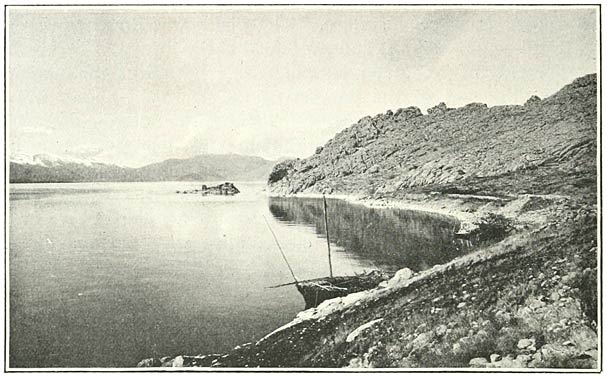
A strand like this one, on the coast of Akhtamar Island, is the setting for Scene 4 in Act I as well as Scene 2 in Act II.

(The first chunk has to wait until I engrave Scene 2 of Act I. Gulp!)

Enjoy.

S3/E3 Looking forward

Writing the evening-long opera took less than a year, to the great surprise of many, including the composer! In an exchange typical of Facebook, my sister-in-law’s congratulations included a dig about my new home’s still-unpacked boxes; the retort after my LOL emoji was that many would undoubtedly be lying around anyway, opera or no!

On the one-year anniversary of starting work on my opus 91 (May 25th), I decided to repost my Facebook entry marking the date here, as S3/E1. Eventually everything there worth keeping will migrate similarly to this more appropriate forum. Recall that in E2 I mentioned that certain folks in my circle could not be prevailed upon to click on a Facebook link, for love or money! For everyone’s convenience I will provide here all the resources that clicking on E1 would avail, which puts us all on the same page.

This explanatory text (from June 13, 2022) that introduced the audio sample linked below was, in fact, my first public message anywhere regarding the project:

“For a while I have had the text for an opera fashioned by a British librettist. Set in medieval Armenia, he sent it to me in three versions, engendering quite a muddle! On May 25th I settled upon which iteration of the first scene I would be setting. Out of my subconscious emerged this bit of exotica, which left no doubt to what use I was supposed to put it. I finished that first scene today, ten minutes of music in complete orchestral detail, and wanted to mark the occasion before collating now the versions of Scene 2. God be with me. We begin with a fanfare announcing the entrance of the local feudal overlord.”

https://www.dropbox.com/s/900kma3b0b33d0a/91Bsample1.mp3?dl=0

A lot of friends and colleagues wished me well, but this comment from Jonathan Clift, the Bradford-based librettist, had to be the most heartening:

“I am knocked sideways! Thank you! it has such melody and at the same time there is a mediaeval/strange feeling to the music thta sets it nicely in Armenia bravo!!”

Similar snippets that accrued in real time as the project progressed, however, were effectively superseded by audio of the first scene entire, once it was finished. This then evolved gradually into a definitive listening version, as I attained greater and greater mastery of the NotePerformer plug-in which had recently been released for the Finale music software I use. Eventually even that would be displaced: by a scrolling score video, as have most (but not yet all at this writing) of my opera’s other scenes. The advantage therein, even for those who don’t read music, is that you can see the lyrics being sung and take cognizance of the stage directions. (A side comment: “This first scene is Music B because A is a short choral-orchestral Prelude I would write later.”)

https://vimeo.com/793877457

From here on in, I will link material from this forum to Facebook and elsewhere, not the other way around. And so we arrive at a common square 1.

S3/E2 Looking back

This WordPress blog began in that singular year 2019 at the inception of my op. 83, a work for three guitars, which ended up being my sole composition that year. In S1/E2, I wrote “I thought I might mark the occasion in real time on my Facebook page, but as I gathered my thoughts I realized that they would have strained that particular medium.” Alas! I lost touch with this insight last year at the tail end of pandemic restrictions being imposed by either self or society. So many of us were using social media to keep in touch even with family and nearby friends and acquaintances that it made concentrated work on blogging seem impersonal and exclusive.

The present S3 will mostly represent a course correction in which the many blog-like entries interpolated into my Facebook profile regarding the development of my op. 91 opera are tidied up here, where they belong! On social media I get the full range of readers, from those who have little interest in my composer’s career to those who have little else. At this point the Facebook material about the opera is hard to access among all my other many posts, and besides, some of my followers eschew the social media giant altogether.

S1 was complete in itself, a good chronicle of the guitar trio from its very inception to the finish line, and its musical examples well illuminated the fine points I wanted to underscore.

S2 was supposed to have been about the work’s making its way into the world. After an initially auspicious reception we hit the mural (as in wall-like) pandemic. With lives being lost, careers being shattered, groups and ensembles broken apart, I regarded it (correctly) as self-indulgent to whine about the fate of my trio no-one had asked for. (I recall poignantly ruing a red-letter day on Facebook when a big orchestral work of mine had been slated for performance by a major French orchestra. I decided to put up a recording of it from a few years earlier, and explained how it was brought to mind after I took notice of the date. I was roundly criticized for this; that’s how bad things were.)

So, after a certain, frustrating point nothing seemed appropriate to be blogging about here and S2 remained incomplete, unrealized. It’s possible that my failure to return here when I decided to do something similar with the opera was owing to the chagrin I retained from that episode in my life. But a life lesson I have managed to learn is always to use the best tool for a given job. And this forum is indeed the best way to interact with those who want to know something about Akhtamar and its origins.